

In today’s world, customers expect immediacy. They want to make appointments, book appointments or order services without having to call, write emails and wait for a response. That is why the website booking system has become not a luxury, but a necessity for every service business – from beauty salons and physiotherapy salons to language schools, workshops and equipment rentals.
A professional WordPress booking plugin works like a trusted assistant that doesn’t sleep. It makes sure that the customer can check availability, choose a convenient date, pay online and receive a booking confirmation at any time. This is not only a great convenience for the user, but also saves time and money for the business owner. Booking automation reduces chaos, double entries, calendar mistakes, and constant questions like, “Is this date still available?”
Thanks to a well-chosen system for booking for the website, the owner can focus on what is really important – on providing services, and not on managing schedules. What’s more, plugins like Amelia or Bookly (Booking WP Plugin) allow you to integrate online payments, send automatic reminders, and even sync data with Google Calendar. This is the level of professionalism that builds the customer’s trust from the first visit to the website.
It’s also worth noting that the WordPress booking plugin has a positive effect on SEO. Google values sites that offer a better user experience, and a fast, intuitive booking process is one of the key factors in increasing conversion rates. A user who can book a service in three clicks rarely returns to the search engine. For business, this means one thing – a higher number of transactions and stable revenue growth.
To sum up, a website booking system is an investment that pays off many times over. It reduces customer service time, increases bookings, improves communication, and eliminates errors. Plugins like Amelia and Bookly are market leaders today – modern, flexible, and built to keep your business running smoothly even when you’re sleeping.
What do we mean by a WordPress booking system and booking plugin?
When we talk about a per-site booking system, we mean a tool that allows the customer to book a service or appointment on their own without the involvement of the business owner. It works completely online, without the intermediation of e-mails or phone calls. In practice, this means that the user enters the website, chooses a service, date, specialist, or makes a payment and receives a confirmation – all in one simple process.
A WordPress booking plugin, on the other hand, is a specific software that is installed on a WordPress-based website. It works as a module that can be adapted to the nature of the business – from booking appointments to selling tickets, courses, consultations or accommodation. Plugins of this type often offer additional features: SMS notifications, integration with Google calendars, financial reports, support for multiple employees and locations.
A well-designed WordPress booking plugin is not just about convenience. It is also an impression of professionalism that builds the user’s trust. When a visitor sees an aesthetic booking form on the website with an online payment option and confirmation, they automatically perceive the company as reliable and modern.
Plugins like Amelia and Bookly have become the foundation of thousands of service sites. Amelia is known for its sleek design, easy setup, and great WordPress integration, making it perfect for salons, beauty salons, and fitness studios. Bookly, on the other hand, stands out for its scalability and a huge selection of add-ons, making it an ideal solution for companies with an extensive structure or many employees.
In the following sections, we will compare the two systems in terms of functionality, price and convenience of use to help you choose the best website booking system that will fit the nature of your business and make your daily work easier.
The most common challenges of service companies – the need for automation, 24/7 availability, payment integration
Service companies, regardless of the industry, struggle with similar problems: too many inquiries, difficulty in keeping a calendar and the constant need to contact customers. Many owners of offices, salons, schools or rental shops still book appointments manually – by phone or e-mail. This is a solution that may work on a small scale, but quickly begins to limit development.
This is where the growing demand for a website booking system comes in. Process automation is not only a time saver but also a way to provide customers with the convenience they expect. A user of the 21st century wants to be able to make an appointment at any time of the day or night, without having to wait for a response from the reception. The WordPress booking plugin allows you to do this instantly – the system works 24/7, serving customers while you’re offline.
Another challenge is payment integration. Many entrepreneurs still accept payment only in cash, which limits the number of customers and complicates the settlement process. A modern booking system allows you to immediately pay for the service through online payment gateways, such as Stripe, PayPal or Przelewy24. Thanks to this, the user immediately finalizes the transaction, and the entrepreneur gains the certainty of booking.
You should also not forget about automatic reminders – this is a feature that really reduces the number of customer absences. An SMS or e-mail sent the day before can increase attendance by up to several dozen percent. Both Amelia and Bookly offer such features, allowing you to build a consistent customer service system.
Service companies that have implemented a WordPress booking plugin often notice that after a few weeks, their work organization becomes clear and predictable. Errors related to double bookings disappear and administrative time is reduced by up to half. This directly translates into higher profits and customer satisfaction.
How can a good WordPress booking plugin increase revenue and improve customer service?
Every owner of a service company knows that a satisfied customer comes back and recommends it further. A good WordPress booking plugin is one of the easiest ways to achieve this effect – not by additional advertising, but by the user experience, which sells in itself.
In practice, this means that the customer can find the service, choose a date, pay and receive confirmation in a matter of seconds. Not having to call and arrange details is a huge relief for both parties. Such a process reduces the number of abandoned queries and failed contact attempts. What’s more, the booking system for the website is available around the clock – your business works even when you are sleeping.
Statistics clearly show that implementing a booking plugin increases bookings by 20-40% in the first months. A customer who can arrange everything online is less likely to change his mind. In addition, automatic SMS and email reminders reduce the number of uncanceled visits, which means greater financial stability.
Amelia is distinguished by an intuitive customer panel – the user immediately sees the available hours, and the system automatically adjusts the duration of services. Bookly (Booking WP Plugin), on the other hand, is more flexible in terms of team management – ideal for businesses with many employees and locations. Both solutions offer online payments and integrated calendars, which avoids chaos and runs your business with the precision of large enterprise systems.
It is also worth mentioning the marketing effect. A site that has a booking system for the site looks professional and modern. Customers perceive the brand as trustworthy and orderly. In industries such as cosmetology, aesthetic medicine, training or fitness, it is often a key factor of competitive advantage.
To sum up – a good WordPress booking plugin is not just a technical tool. It is an investment in customer experience, image and revenue stability. In the following sections, I’ll show you how Amelia’s and Bookly’s functionalities translate into real benefits and which ones can best suit your type of business.

A brief overview of booking systems on the website
The market for booking plugins for WordPress is developing very dynamically. Among the available options, several solid solutions stand out, but two of them have won particular recognition from users – Amelia and Bookly (Booking WP Plugin). Both plugins work as a comprehensive booking system for the website, automate the customer service process and offer full integration with the most popular payment tools and online calendars.
Below you will find a brief introduction to each of them so that you can better understand how they work and who they are aimed at.
Amelia – Quick Introduction
Amelia is a modern, clear and extremely intuitive WordPress booking plugin that has been designed with users who value aesthetics and simplicity of use in mind. It is ideal for service industries such as beauty salons, hairdressers, medical clinics, language schools, gyms or online consultants.
Its biggest advantage is that it combines a sleek design with powerful features. The booking form can be easily adapted to the appearance of the website, thanks to which the booking system does not disturb the aesthetics of the website, but becomes an integral part of it. The user can see the available appointments in real time, can choose a service, a specialist, and even pay online right away.
Amelia supports payments via Stripe and PayPal, and it also allows integration with WooCommerce. All bookings are automatically saved to your calendar – both in your WordPress dashboard and in Google Calendar, which avoids double deadlines. The plugin also allows you to send SMS and email reminders, which significantly reduces the number of forgetful customers.
An additional advantage is the administration panel, which looks like an application – modern, responsive and very intuitive. A business owner can view appointment occupancy, revenue, statistics, and customer history in seconds. In practice, Amelia is an ideal booking system for people who value simplicity, stability and elegant design.
Bookly – Quick Introduction
Bookly (Booking WP Plugin) is the second extremely popular WordPress booking plugin that focuses on flexibility and scalability. It is a solution created for companies that need an extensive system for managing multiple services, employees and locations.
Bookly operates in a modular model – this means that it can be adapted to the needs of the business by purchasing selected extensions (so-called add-ons). This allows the plugin to grow with your business. You can start with the basic package and over time add features such as group bookings, support for multiple time zones, CRM integration, or more advanced sales reports.
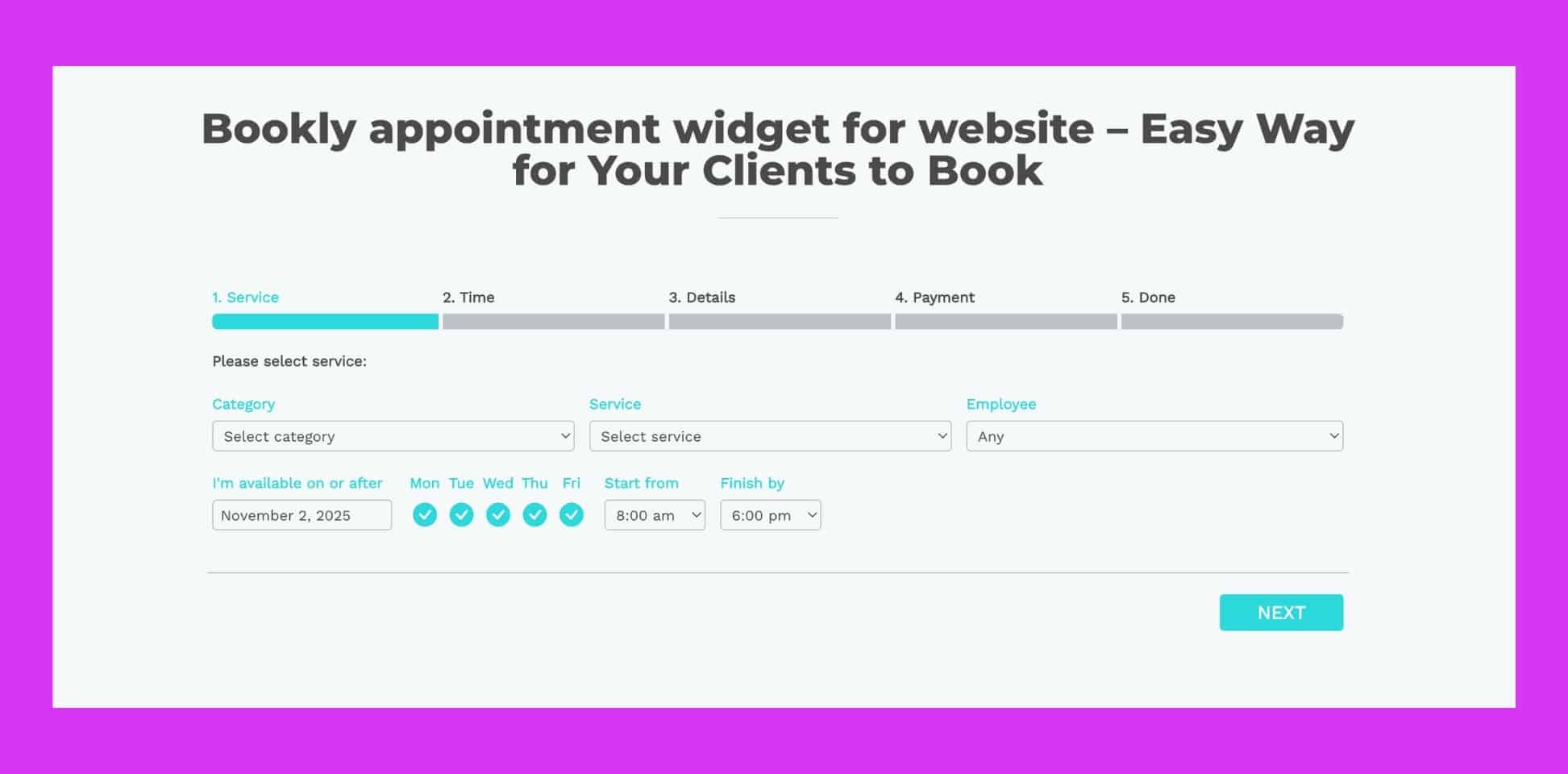
The interface of Bookly is simple yet functional. The customer makes a reservation in a few steps, sees the available specialists and hours, and after choosing a date, they can immediately pay online. Like Amelia, Bookly integrates with Stripe and PayPal payment systems, but also offers cash or post-service payment options.
What sets Bookly apart is its sheer number of configurations – a business owner can create different types of services, set individual rates for each employee, and even assign different service durations depending on the category. For businesses that are growing and need more than just a simple form, Bookly is one of the most flexible booking systems on the market.
Basic functions of the booking system
Every modern website booking system is based on several pillars: an intuitive form, a clear calendar, efficient service management and the ability to work with a team. It is these elements that determine whether the user will complete the booking process, and the business owner will be able to easily plan and monitor their business. In this section, we’ll take a look at how Amelia and Bookly, which are two of the most recognizable WordPress booking plugins, are doing this.
Booking form and UI/UX
The booking form is the first place a user comes into contact with the system. It must be simple, legible and fast. The customer does not want to click on ten tabs – they have to see the available dates, choose a service and make a reservation in a few steps.
In this respect, Amelia looks extremely modern. Its interface is clean, responsive and designed to work flawlessly on both computers and smartphones. The user immediately sees the available hours, and as the option is selected, the system dynamically adjusts the offer. The form is fully customizable, changing the colors, fonts, and layout to match the style of the page. This makes Amelia fit perfectly into the visual language of the brand and does not look like an external accessory.
Bookly, on the other hand, focuses on functionality and versatility. The booking form acts as a smart wizard that guides the customer step by step through the process: choosing a service, specialist, date, contact details and payment. Although its appearance is less modern than that of Amelia, flexibility is a huge advantage. Bookly allows you to easily edit each stage of the form, add custom fields (e.g. pre-visit questions), and create different versions of forms for different services or locations.
In the context of UX (user experience), both plugins meet the highest standards, but in a slightly different way. Amelia attracts with its modern design and smooth operation, which makes it a great choice for premium brands. Bookly, on the other hand, focuses on full control over the booking process – it is an ideal solution for companies that like to adapt every detail to their own procedures.
In practice, if you care about elegance, simplicity and quick implementation, Amelia will be a better choice. If you need an extensive form with custom fields and booking logic, Bookly will provide you with more configuration options.
Calendar, service and employee support
The second key element, without which no booking system for the website can work effectively, is the calendar. It’s the command center of the entire system — the place where the business owner can see who, when, and what service they have booked.
Amelia has one of the most intuitive calendars of any WordPress booking plugin. The calendar can be viewed in daily, weekly, or monthly views, and each reservation is color-coded to quickly get an idea of your schedule. The plugin supports multiple employees and locations, making it great for companies with a team of specialists. Each employee can have their own account and access to their schedule, which makes it much easier to organize work.
A big plus of Amelia is the integration with Google Calendar – changes made in one place are automatically updated in another. If a customer cancels an appointment, the employee immediately sees a free appointment. This eliminates errors and allows you to make the most of the available hours.
Bookly focuses on scalability in this aspect. Its calendar is more extensive and allows you to handle up to dozens of employees and locations. For larger companies, this is a huge advantage – the manager can filter the calendar by services, employees or branches, and the system immediately shows available places. The plugin also supports SMS and email reminders, as well as recurring bookings – useful for example in language schools, fitness studios or courses.
When it comes to service management, both plugins offer great opportunities. In Amelia, each service can be described, categorized, its duration and price can be set, and buffer time can be defined between visits. Bookly adds to this the ability to create price lists for different employees, which gives you more flexibility in large teams.
All in all, Amelia wins with simplicity and speed of use, while Bookly outperforms it in terms of scalability and configurability. For small and medium-sized companies that value intuitiveness, Amelia will be a hit. For large structures with many employees and complex work organization — Bookly will prove to be unbeatable.
Email/SMS notifications
In today’s world, effective communication with the customer is the basis of any service activity. Even the best booking system for the website loses its meaning if the user does not receive clear information about their reservation, reminders or changes in the schedule. That’s why automatic email and SMS notifications are one of the most important features that a modern WordPress booking plugin should have.
Amelia offers full automation in this regard. Each booking can generate a confirmation that is sent automatically to the customer and employee. The system allows you to create personalized message templates where you can include your company name, service details, address, cancellation link, or booking confirmation QR code. Notifications can be sent via email or SMS, and each can be scheduled at a specific time—for example, a reminder 24 hours or 2 hours before your appointment.
With integration with third-party services like Twilio, Amelia allows you to reliably send SMS messages to any number. Importantly, the plugin saves the history of sent notifications, so the business owner has full control over communication with customers.
Bookly, on the other hand, goes even further. It offers a very extensive messaging automation system that can be freely configured. A business owner can set different messages for different services, languages, or employees. Additionally, Bookly allows you to send payment reminder messages, follow-up messages after the service is performed, and even automatic thank you messages for regular customers.
The plugin supports SMS notifications via popular gateways (m.in. Twilio, Plivo, Nexmo) and email via SMTP, which ensures high deliverability. For large companies, this is a huge convenience – the entire communication process is automated and does not require any manual operation.
All in all, Amelia offers a simple and effective notification system that is enough for most small and medium-sized businesses. Bookly , on the other hand, gives you full control and almost unlimited flexibility in configuration – it is an ideal solution for businesses that need complex communication scenarios and want to automate contact with customers as much as possible.
Online payment integration
In the age of digital transactions, customers expect to pay for a service at the same time they book it. Therefore, a system for booking to a website without online payment integration does not have a raison d’être today. A modern WordPress booking plugin must allow fast, secure and diverse payment methods so that the customer does not have to leave the site.
Amelia offers full integration with two of the most popular payment systems – Stripe and PayPal. Thanks to this, you can easily accept payments by credit card, BLIK or digital wallet. The plugin also allows you to connect to WooCommerce, which gives you access to Polish payment operators, such as Przelewy24, PayU or Tpay.
In practice, it looks like this: the customer chooses a service, a date and a specialist, and then proceeds to payment. After the transaction is made, the system automatically marks the reservation as paid, sends a confirmation and blocks the date in the calendar. The whole process runs smoothly, without the need to reload the page.
Bookly also supports Stripe and PayPal, but its advantage is the ability to add multiple payment methods with extensions. You can set up cash payments, traditional transfers, post-service payment, or integrate the system with WooCommerce to use any payment gateway.
For larger companies, Bookly has another advantage – payment reports. The owner can analyze which services are most often paid for online, monitor booking revenue, and track the status of each transaction. This is a feature that helps you plan sales strategies and streamlines financial management.
To sum up: Amelia impresses with the simplicity and speed of payment implementation, while Bookly offers extensive opportunities for companies that want to have full control over the way services are billed. In both cases, integration with online payments increases conversion and user experience, which translates directly into revenue growth.
Responsiveness and compatibility with WordPress
A modern booking system for a website must be responsive, i.e. look and work perfectly on any device – laptop, tablet or smartphone. Most users today make reservations from their phones, so the appearance and smoothness of the form is a key issue not only for UX, but also for SEO.
Amelia is fully responsive. The booking form automatically adjusts to the width of the screen, maintaining readability and smoothness. Even on older smartphones, the interface loads instantly, which has a positive effect on the Core Web Vitals indicator and the site’s ranking in Google. The plugin works seamlessly with popular WordPress themes – including Divi, Elementor, Astra, or OceanWP – and the latest PHP versions.
Bookly is also fully responsive, but takes a slightly different approach. The interface is simpler, less graphic, so it loads very quickly even with a large number of elements on the page. For website owners, this is a huge advantage – the form does not slow down the website, which is important with high traffic. The plugin is also compatible with most popular WordPress builders and themes, and its integration with Gutenberg allows you to easily insert the form anywhere on the page.
From an SEO and user experience standpoint, both plugins perform excellently. Amelia focuses on a sleek design and full visual integration with the site’s theme, while Bookly focuses on maximum speed and simplicity of operation. Each of them works stably in the WordPress environment and is regularly updated, which guarantees security and compatibility with new versions of the system.
To sum up, if you are building a service website based on aesthetics and UX – choose Amelia. If performance and scalability are a priority – Bookly will be a reliable solution. Both plugins provide a solid foundation for a professional, responsive booking system for the website that works without interruptions, errors and technical limitations.
Deeper Comparison: Amelia vs Bookly
Amelia – strengths
Amelia stands out for its combination of an elegant interface with features that really relieve the team and speed up customer service. For a business owner, this means a booking system for a website that works intuitively from the first launch and does not require complicated implementation. The forms are modern, readable and visually consistent with the theme, which increases user trust and booking conversion. It’s a WordPress booking plugin designed to reduce setup time and simplify your day-to-day work, regardless of the service industry. Amelia scales well from a one-person business to a team with multiple locations, keeping calendars and stats transparent.
Intuitive panel and easy setup
Amelia’s dashboard works like a lightweight app where it takes minutes rather than hours to quickly add services, price lists, and staff. The wizard guides you step by step, so you can insert the booking system on any subpage and start accepting registrations right away. Daily, weekly, and monthly views make planning easy, and reservation colors allow you to get an instant assessment of occupancy. It’s a WordPress booking plugin that doesn’t overload with technical settings, but proposes sensible default configurations that can be refined later. This allows the team to move faster from the testing stage to real bookings and online payments.
Sync with Google Calendar, SMS notifications
Amelia offers two-way synchronization with Google Calendar, so every booking from the site immediately appears on the employee’s calendar and vice versa. This eliminates duplicate listings and allows you to efficiently manage availability across multiple channels, which is crucial when the booking system works in parallel with other tools. Automatic email and SMS notifications remind you of appointments, inform you of changes, and send thank you notes after the service, which reduces absences and builds relationships. In practice, this WordPress booking plugin closes the communication loop: booking, confirmation, reminder and possible change are handled without the involvement of the reception and the owner sees the full contact history in the panel.
Integrations (WooCommerce, Payments, WordPress Divi)
One of Amelia’s greatest strengths is her integrations. This WordPress booking plugin is designed to work seamlessly with the most popular solutions used on service and e-commerce websites. This allows it to be connected to the existing ecosystem of the website, without having to rebuild the website or change the theme.
Amelia integrates with WooCommerce, which gives you great opportunities for billing and sales automation. In practice, each reservation can be treated as a product – you can assign a VAT rate, apply discount coupons, add an invoice or combine the reservation with other products in the store (e.g. passes, vouchers, subscriptions). This is an ideal solution for companies that sell both products and services – e.g. beauty salons offering online treatments and cosmetics.
When it comes to payments, Amelia supports PayPal, Stripe, WooCommerce Payments, and popular gateways in Poland through integration with WooCommerce (PayU, Przelewy24, Tpay). The customer can pay immediately when booking, which significantly reduces the number of unpaid or unconfirmed visits. The payment is automatically assigned to the reservation and recorded in the system, eliminating the need to manually check deposits.
It’s also worth noting that Amelia works perfectly with the Divi WordPress theme, which is one of the most chosen by agencies and freelancers. The plugin adds its own shortcodes and blocks that can be easily inserted anywhere on the page – in a section, column, module, or pop-up. Thanks to this, you can create an aesthetically pleasing, converting landing page with a booking form without touching the code. For Divi users, this is a huge advantage, because the website booking system fits into the style of the website and works fully responsive.
In practice, this means that a website owner can combine a beautiful design with Divi, sales with WooCommerce, and full payment automation – all within a single, consistent platform. It’s this integrative flexibility that has earned Amelia a reputation as one of the most versatile WordPress booking plugins on the market.
When is Amelia a great choice?
Amelia works best where aesthetics, simplicity of use and one-on-one contact with the customer are important. It’s the perfect booking system for small and medium-sized service companies that want to look professional and act like automated premium brands.
Great for:
-
beauty salons and aesthetic medicine clinics,
-
hairdressing salons and spas,
-
personal trainers, fitness and yoga instructors,
-
psychologists, therapists and coaches,
-
advisors, lawyers, online specialists (e.g. consultations via Zoom),
-
photographers, stylists and freelancers offering meetings with clients.
Amelia is especially appreciated in industries where individual service and visual professionalism are important. Booking forms look aesthetically pleasing, are easy to use, and encourage you to finalize. Thanks to this, the number of completed reservations increases naturally – without the need to invest in additional ads.
For businesses that want to combine a sleek WordPress site with Divi and an automated save process, Amelia is almost the perfect solution. It’s a WordPress booking plugin that combines the essentials – functionality, design, and efficiency. If you want your website to work for you 24/7 and for customers to book appointments without any obstacles, Amelia will do this job one hundred percent.
Amelia – limitations / when to consider something else
Even though Amelia is one of the best-designed booking plugins on the market, it’s not a perfect tool for everyone. Its greatest strength is simplicity, and this is also the biggest limitation when it comes to very complex booking structures. Therefore, it is worth knowing when the Amelia website booking system may turn out to be too simplistic and when it is better to consider other solutions.
Amelia was created mainly for service industries where the time of a specialist or a specific service is reserved. Its architecture is perfect for beauty salons, offices, language schools or online consultations. However, in the case of activities based on renting space, rooms, cars or equipment – the plug may not be enough.
It does not fully support a resource booking system, where a single item (e.g., a room, a car, or a room) can be rented by multiple users in different configurations. While Amelia allows you to create multiple employees and locations, it doesn’t manage the complex availability of multiple units of the same type. In such cases, plugins dedicated to rentals, such as MotoPress Hotel Booking, WP Rentals or Bookly in a version extended with resource modules, work better.
When it comes to integrating with the Divi WordPress theme, Amelia works perfectly with it on a visual level, but Divi users should note that not every plugin module is fully customizable in the front-end editor. This means that more advanced modifications to the appearance of the booking form (e.g. changing the structure of steps or arranging fields) may require working with shortcode or CSS, rather than the Divi wizard. This is a minor issue for most users, but with custom designs with multiple sections, it may require technical consultation.
It is also worth adding that Amelia does not have built-in features for the hospitality industry: no support for seasonal rates, calendars with multiple rooms or synchronization with OTA portals (e.g. Booking.com, Airbnb). So, if your business relies on accommodation rentals or property reservations, it’s better to consider Bookly or dedicated resource reservation systems.
All in all, Amelia is the perfect WordPress booking plugin for businesses that offer time-based and one-on-one services. However, if your business requires managing a large number of resources, dynamic pricing, or synchronization with external booking channels, this system may be too limited. Then it is worth taking a look at Bookly, which is better able to handle complex structures, or connect Amelia to an external rental system via API.
Bookly – strengths
Bookly is a real harvester in the world of WordPress booking plugins. This per-site booking system is known for its flexibility, scalability, and huge configuration options. Unlike many simpler solutions, Bookly allows you to design your booking process exactly how your business works – without compromise or limitations.
For WordPress users, this means that regardless of the industry – a hair salon, a language school, a hardware rental, a clinic, or a large network of service outlets – you can create a complete booking system that will serve thousands of customers without sacrificing efficiency.
Flexibility: services, employees, schedules, CSV import/export
The basis for Bookly’s success is its flexibility. The plugin allows you to define an unlimited number of services, categories, locations, and employees. Each employee can have an individual schedule, rates, breaks, and working hours. Thanks to this, the plugin fits perfectly into the reality of companies that offer a variety of services in different places or with different specialists.
For example: a beauty salon can make reservations for manicures, massages and beauty treatments in one calendar, and each employee can have their own set of services and hours of availability. The system automatically assigns the reservation to the right person and updates their calendar.
Bookly also gives you access to import and export data in CSV format, allowing you to easily manage a large amount of information – from customer lists to visit or payment history. This is especially important for companies that are migrating from other software or want to conduct offline analytics.
Compared to Amelia, Bookly offers more freedom in matching your booking logic. You can create custom forms, add questions, vary the duration of services depending on your options, and even bundle several services. This makes it one of the most customizable per-site booking systems available for WordPress.
Rich add-ons – extension of the booking system to the website
One of the reasons why Bookly has gained so much recognition is because of its add-ons system. These are modular extensions that allow you to expand the plugin with specific features, tailored to the needs of your business.
This allows you to start with the basic version of the plugin and add more elements over time as your business grows, such as:
-
SMS and email notifications at specific times,
-
group or recurring bookings,
-
multi-location management,
-
integrations with CRM or Google Meet,
-
different time zones for international clients,
-
automatic reminders and follow-up messages after the visit,
-
Sales reports and statistics.
Thanks to its modular design, Bookly does not overload the system with unnecessary functions. You choose only the ones you really need, which allows you to stay efficient and control over costs. Each add-on is installed as a separate plugin and fully compatible with the main system.
This approach makes Bookly an extremely flexible tool. For small businesses, a basic version is enough, but large organizations can build a complete, multi-level booking system for the website that works like professional SaaS software.
Pricing Model (Free Starter, Pro Plan)
Unlike many competing plugins, Bookly offers a very reasonable and scalable pricing model. The basic version of the plugin is free, which allows anyone to test its capabilities and create a simple booking system at no cost. This version already includes a booking form, calendar, email notifications, and service and employee management.
For more demanding users, there is Bookly Pro, which is a paid premium version that unlocks additional integrations, support for online payments, SMS, notification personalization and the ability to use add-ons. The price of the Pro license is one-time and very competitive compared to other premium solutions.
In practice, this means that you can start with the free version, test the system, and only then move on to the full version as your business grows. This is a huge advantage for new businesses that do not want to invest large funds to start.
Bookly also offers updates and technical support as part of the Pro plan, which guarantees stability and security.
Bookly – limitations / when it can be exaggerated or too extensive
While Bookly is one of the most flexible and extensive tools available for WordPress, not everyone will need its full power. In many cases, this WordPress booking plugin turns out to be just too complicated, especially for smaller businesses that need a simple solution that works “off the shelf”.
The main disadvantage of Bookly is its modular structure – on the one hand, it is a huge advantage, because it allows you to develop the system as needed, but on the other hand, it requires you to buy add-ons to get full functionality. Each module costs separately, which can quickly increase your total expense if you want everything – SMS notifications, online payments, WooCommerce integration, Google Calendar, or group bookings.
As a result, instead of a simple system, a small entrepreneur can get an extensive platform, the configuration of which requires time, testing and knowledge of the WordPress structure. It’s a bit like buying a sports car, when a solid city model would be enough – the performance is impressive, but everyday use requires patience and practice.
Another limitation is the user interface. Although transparent, it is more technical and less aesthetic than in Amelia. Not every user will find themselves in the maze of tabs and settings, especially if they have not worked with advanced WordPress tools before.
It’s also worth mentioning that Bookly can be a bit resource-intensive with a large number of add-ons. Each module is a separate script, which in some cases can affect the loading speed of the page, especially if the website is hosted on a cheaper shared server.
For these reasons, Bookly tends to be too powerful for small sole proprietorships that simply need a simple booking form with confirmation and payment. In these cases, Amelia works better – it’s faster to implement and less overwhelming.
Bottom line: Bookly is an excellent choice for large or growing businesses with many employees, branches, and a variety of services. However, if you run a beauty salon, massage studio, law firm or individual practice, this booking system may be too complex for you. Then Amelia’s simplicity will simply turn out to be more practical.
Comparison in the table – which choice for which needs?
| Criterion | Amelia | Bookly (Booking WP Plugin) |
|---|---|---|
| Difficulty | Very easy to set up – ready to use after installation | Requires more time and knowledge of WordPress |
| Design and interface | Modern, elegant, consistent with the theme of the website | Classic, more technical |
| For whom | Small and medium-sized service companies, individual specialists | Medium and large companies, service networks, institutions |
| Integrations | WooCommerce, Stripe, PayPal, Google Calendar, Divi | WooCommerce, Stripe, PayPal, Google Calendar, CRM, API add-ons |
| Scalability | High but limited to a single service | Very high – many locations, employees and services |
| Notifications | Email and SMS in a simple panel | Email and SMS with advanced scheduling and automation |
| Payments | Integrated with WooCommerce and popular gateways | Supports multiple methods, but some require add-ons |
| Price | One-time license – full functionality in the | Free starter version + paid add-ons |
| Divi | Full, elegant theme | Works with Divi but requires shortcode matching |
| Customer Service Support | Intuitive dashboard and quick implementation | Support via ticket system, documentation for developers |
| Best Use | Offices, salons, online consultations, trainers, coaches | Schools, salon chains, companies with many employees, service facilities |
The conclusions of the comparison are clear:
-
Amelia is a plugin for those who value simplicity, aesthetics and want to quickly launch a system to book on the website without technical complications.
-
Bookly is a solution for entrepreneurs who need maximum flexibility, want to manage a large number of services and employees, and expand the system with non-standard functions.
In both cases, you get a proven, professional booking system for WordPress that automates customer service, supports online payments, and increases booking conversion. So the choice comes down to the philosophy of your business: simplicity and elegance – Amelia, or scalability and power – Bookly.

Pricing and licensing model
Choosing a system for booking on a website is not only a matter of functionality, but also of investment. A well-chosen WordPress booking plugin can not only improve the operation of the company, but also reduce service costs and increase revenue. However, it is crucial to understand what exactly the license offers, what the real costs of maintaining the system are, and when it pays to invest in a more extensive version.
In this section, we’ll look at two models: Amelia – a plugin that offers full functionality under a single license, and Bookly – a modular system where you pay for what you actually use.
Amelia Costs – What Do You Get in a Basic License (WordPress Divi)?
Amelia offers a very transparent pricing model. All the most important functions are available under a single license, without the need to purchase additional add-ons. This means that when you buy a plugin, you immediately get a complete booking system for the website, ready to be implemented.
The license includes:
-
full version of the plugin (no limit on the number of reservations),
-
integration with WooCommerce, Stripe, PayPal,
-
handling e-mail and SMS notifications,
-
full synchronization with Google Calendar,
-
management of multiple services, locations and employees,
-
automatic reports and statistics,
-
updates and technical support for one year.
Amelia’s prices start at a few dozen dollars per year for a one-page license. For larger projects, multi-seat licenses are available. Importantly, there are no hidden costs here – there is no need to buy add-ons, as in the case of some competing solutions.
If you use WordPress with a Divi theme, Amelia integrates with it perfectly. You can insert a booking form anywhere on the page – in a section, column, or Divi module – without the need for coding. This gives you a full-featured booking system that looks consistent with the rest of your website and works instantly.
In practice, this means that even at a small cost of a one-time license, you get a premium solution that works without the need to buy additional extensions. For small service companies, this is a huge advantage – a low barrier to entry and a quick return on investment.
Bookly Costs – Start, Pro Plan
Bookly operates in a completely different model than Amelia. It’s a modular booking system for the site where you only pay for the features you really need. For many companies, this is an ideal solution, because it allows you to start with the free version and only then expand the system as the business develops.
You will find three basic price variants:
-
Bookly Start (Free) – free version with a basic booking form, calendar and email support. Sufficient for small businesses that are just starting out.
-
Bookly Pro (Premium License) – a one-time fee for the full version that unlocks integrations with online payments, SMS, Google Calendar, WooCommerce, and add-ons.
-
Add-ons – paid modules that can be purchased separately. Each add-on costs from a few to a dozen dollars and expands the capabilities of the system (e.g. group bookings, advanced reports, CRM integrations).
Unlike Amelia, where everything is in one package, Bookly allows you to build the system gradually. For large companies, this is a huge advantage – you can create exactly the set of features you need, without overpaying for unused options.
However, it is worth remembering that the full, extensive Bookly system (with the most important extras) can cost more than Amelia. If you plan to use SMS notifications, online payments, WooCommerce, and reports, the total price can reach several hundred dollars. This is still an attractive investment for large companies, but for smaller businesses, Amelia’s one-off package may be more profitable.
Cost vs value analysis – when is it worth investing in an advanced booking system?
The decision on which booking system to invest in depends on the scale of the business and the expected return on investment. For micro-entrepreneurs, the most important thing is that the plugin works without configuration and is easy to use. For larger companies – so that it can grow together with business.
Amelia is an all-in-one solution. You buy once and you have it all: calendars, payments, notifications and reports. Ideal for businesses that want to have a stable system without having to analyze every add-on.
Bookly, on the other hand, is a tool for those who think long-term – they want to start with a simple system, but add more features over time. As a result, its cost increases in proportion to your needs, but you gain full flexibility.
From a business point of view, an investment in an extensive booking system begins to pay off when:
-
the number of customers exceeds several dozen bookings per month,
-
several people in the company use the same calendar,
-
you want to implement online payments, SMS reminders and automatic reports,
-
Your website is starting to generate traffic and you want the booking system to work 24/7 without manual operation.
Then automation becomes not a luxury, but a necessity. Both Amelia and Bookly can significantly increase conversion and reduce operating costs at this point.
Budget Tips for Small Service Businesses
If you run a small business, e.g. a beauty salon, massage parlor, law firm or fitness studio, you don’t need an extensive system with dozens of accessories right away. It is worth starting with a simple solution that will bring a quick effect and will not burden the budget.
Here are some practical tips:
-
Start with Amelia or the free version of Bookly. Both plugins allow you to launch the booking system in a few hours.
-
Don’t overpay for features you won’t use. If you don’t make group bookings or don’t have multiple locations – don’t buy add-ons in stock.
-
Leverage WooCommerce in Divi. This makes it easy for you to add payments and invoices without external integrations.
-
Take care of UX and SEO. Place the booking form in a visible place on the page, preferably in the top section, and optimize it for the keyword “booking system for the website”.
-
Test and measure conversion. Check how many users complete the booking process – this will help you assess the real return on investment.
A well-implemented WordPress booking system is an investment that pays for itself quickly – especially when combined with payment automation, reminders, and calendar integration. Even a small business can act as a large, organized team this way – and that’s the biggest value of modern plugins like Amelia and Bookly.

WordPress integration and other technical aspects
A well-designed booking system for a website should not require technical programming knowledge from the owner. The plugin must be simple to install, intuitive to set up, and fully compatible with the rest of the site’s elements – especially the theme and page builder. Both Amelia and Bookly meet these requirements, but differ in their level of technical flexibility and deployment.
Implementation in WordPress – installation, configuration, shortcodes
Both Amelia and Bookly can be installed in the classic way – via the WordPress panel or by uploading a ZIP file. After activating the plugin, a new section appears in the admin panel, from which you can manage all settings, calendars and booking forms.
Amelia is more user-friendly in this regard. After installation, a simple setup wizard starts that walks you through the step-by-step process of adding services, employees, and locations. After just a few minutes, you can have a ready-made booking form that can be placed on the website using a simple shortcode (e.g. [ameliaevents], [ameliabooking]). This way, you don’t have to create complicated pages or know HTML – just copy the code and paste it into any section of the page.
Bookly requires a bit more configuration, especially in the extended version. The system works on the basis of many modules that need to be activated and adjusted to your needs. However, in return, you get very detailed control over every step of the booking process – from form fields to automated messages. The form can also be inserted using a shortcode ([bookly-form]), which works in all WordPress page editors.
For users who value simplicity and speed of implementation – Amelia will be ready to go almost immediately after installation. For people who like to match every detail, Bookly will offer much more room for maneuver.
Theme/page builder collaboration (e.g., Elementor, Divi)
One of the most common questions when choosing a booking plugin is: “will this work with my theme?”. The answer for both tools is yes, but with some differences.
Amelia is designed to look great regardless of the theme. Its design is modern, responsive, and fully compatible with popular builders such as Elementor, Divi, Gutenberg, and WPBakery. You can insert a booking form as a block, section, or module, and its colors, fonts, and buttons automatically adapt to the style of the page.
With the Divi WordPress theme, the integration is particularly smooth. Amelia doesn’t require any additional extensions – just insert the shortcode into the text module or code and adjust the margins and width. The booking form retains the Divi aesthetic, and the whole process looks like a native page element, not an external add-on.
Bookly also works with popular builders, but it has a more neutral design. The interface is functional, but less graphical – it resembles classic booking forms. It can be incorporated into the Divi or Elementor website, but sometimes it requires minor CSS tweaks to fully match the colors and sizes of the buttons. The advantage of Bookly, on the other hand, is that its form can also be embedded in a sidebar, pop-up or dedicated user panel.
Bottom line: Amelia is the perfect solution if you want full visual consistency with your theme (e.g. Divi). Bookly will be better when you want to place your form in different places on the page or build a custom layout with the help of shortcodes and CSS.
Performance and SEO – what to look for (e.g. loading speed, responsiveness)?
For many website owners, especially service owners, it is crucial that the website booking system works instantly and does not burden the website. Both Amelia and Bookly have been optimized for performance, but they differ in how they load scripts.
Amelia is very lightweight—most of her code loads asynchronously, so the form doesn’t slow down the page. The plugin has been well optimized for Core Web Vitals, which translates into better SEO results. In practice, this means that even on pages with a lot of graphics (typical for a Divi or Elementor theme), Amelia does not negatively affect loading times.
Bookly, especially in an extensive configuration with many add-ons, may require a bit more resources. Each active module is an additional script that needs to be loaded, which can slightly increase page load times. The difference is not big, but in the case of more demanding websites (e.g. integrated with WooCommerce and additional marketing plugins), it is worth performing cache optimization and file minification.
Both plugins are fully responsive, which is of utmost importance for SEO and conversions. Booking forms automatically adapt to the screens of smartphones and tablets. Amelia focuses on visual fluidity and aesthetics, Bookly – on speed and simplicity. As a result, each of them supports the positioning of the website, improving the user experience and conversion rate.
Security and updates – why important for a WordPress booking plugin?
The booking system stores customer data – names, surnames, email addresses, phone numbers, and sometimes payment history. Therefore, the security of the WordPress booking plugin is crucial, especially in the context of GDPR regulations.
Amelia is regularly updated and maintained by the TMS Plugins team. The updates include not only bug fixes, but also new features and security improvements. The plugin uses secure HTTPS connections and does not store payment card data – all transactions are carried out by external, certified payment systems (Stripe, PayPal, WooCommerce Payments).
Bookly, also has very robust security. Each update is verified for compatibility with the latest versions of WordPress. The plugin has built-in reservation backup systems and allows you to export customer data, which makes it easier to meet GDPR requirements.
Both plugins work stably and are actively supported. The key difference is the frequency of updates – Bookly is updated almost every month (due to its numerous modules), while Amelia receives smaller but more polished updates every few weeks.
For WordPress Divi website owners, this means full compatibility and security – regardless of which plugin you choose. It is only important to install updates regularly and take care of your database backups.
User experience (UX) and end user (booking customer)
A user who enters the site does not think about how the booking system works – he simply wants to quickly find a service, choose a date and confirm the visit. Therefore, when evaluating any WordPress booking plugin , the UX (user experience) is crucial, i.e. how easily and intuitively the customer can go through the entire process. In this aspect, both Amelia and Bookly offer very good solutions, but their approach to the user differs in philosophy.
Amelia – what does the booking process look like for the client?
The Amelia plugin is designed for maximum simplicity. This is one of those cases where aesthetics go hand in hand with usability. The booking form is light, intuitive and fully interactive – the customer can immediately see what services are available, who performs them and on what dates.
The booking process is done in four simple steps:
-
Choosing a service or category. The user sees a clear list of available services with prices, description, and duration.
-
Choosing a specialist. If the company employs several employees, the client can choose the person they want to make an appointment with – e.g. their favorite hairdresser, trainer or therapist.
-
Choosing a date. The system automatically shows only the available days and times, eliminating the risk of double bookings.
-
Confirmation and payment. Finally, the customer enters their contact details, possibly pays online and receives a booking confirmation by e-mail or SMS.
The whole thing takes place on one page, without reloading. This is a big advantage of Amelia – the form works like a SPA (Single Page Application) application, making the process instant and user-friendly.
Visually, Amelia works perfectly with the Divi WordPress theme and other builders. Colors, fonts and buttons can be matched to the appearance of the website, which makes the customer feel like using a professional system, not a pasted add-on.
From a UX point of view, Amelia focuses on emotional fluidity. Everything is simple, clear and logical. There are no excess fields, drop-down lists or unnecessary clicks. A customer can book a visit in seconds, which significantly increases the conversion rate.
This approach makes Amelia particularly popular in industries where the customer’s image and trust are crucial – beauty salons, aesthetic medicine clinics, trainers, therapists or online consultants.
Bookly – customer experience, the ability to customize forms
Bookly represents a more flexible, technical approach to UX. It may not be as visually polished as Amelia, but it allows you to create exactly the booking process that suits your business.
The form in Bookly works step by step, and each step is fully customizable. The administrator can decide which fields are mandatory, which ones to appear conditionally, and which ones can be omitted. This makes it possible to expand the booking process with additional questions, text fields, GDPR consents, selection of service variants, and even files sent by the customer.
The default booking process is as follows:
-
Choosing a service and an employee. The customer chooses the service and specialist they are interested in.
-
Date and time selection. The system only shows available deadlines and allows filtering if necessary.
-
Contact details and payment. The customer enters the data, selects the payment method and confirms the reservation.
-
Confirmation. Once the process is complete, they receive an email or SMS with a summary.
In the standard version, the Bookly interface is minimalist – without unnecessary frills, but very fast. It can be embedded anywhere on the page, in a pop-up or a dedicated module. For companies that focus on personalization, there are CSS themes and a number of appearance settings in the administration panel.
The biggest advantage of Bookly is the ability to create custom user paths. For example, you can set up different forms for different services, different messages for regular customers, or enable group booking mode. No other WordPress booking plugin offers such flexibility.
Bookly is ideal for businesses that have multiple services, locations, or employees. It allows you to scale the customer experience – from a simple form to a complex booking system with automatic reminders and multiple payment methods.
To sum up:
-
Amelia – focuses on visual elegance, simplicity and speed. Perfect for businesses that want to maintain a lightweight, premium website design.
-
Bookly – gives you full control over the booking process. A great choice if your business has a variety of services or you want to tailor each stage of your booking to your own procedures.
Quick “who for whom” – summary table
| criterion | Amelia | Bookly (Booking WP Plugin) |
|---|---|---|
| Business Type | Small and medium-sized companies, offices, salons, online | Companies with many employees, schools, service centers, large chains |
Purpose |
Quick implementation and simple booking | Maximum flexibility and extensive functions |
| Design and UX | Modern, matched to a WordPress theme (e.g. Divi) | Classic but fully customizable |
| Integrations | WooCommerce, Stripe, PayPal, Google Calendar, Divi | WooCommerce, CRM, Stripe, PayPal, Google Calendar, hundreds of add-ons |
| Total | One-time license, no need to buy add-ons | Free version + paid extensions, higher cost in full configuration |
| Speed of action | Lightweight, lightning-fast, well-optimized for SEO | Very fast, but needs to be optimized with many add-ons |
| Scalability | Great for several employees and locations | Excellent for large teams, structures, and multiple services |
| Difficulty | Very easy to use, beginner-friendly | Medium – requires configuration and knowledge of WordPress |
| Working with Divi / Elementor | Full integration, forms look consistent with the website | Works with Divi and Elementor, but requires style matching |
| The biggest advantage | Elegance, simplicity, automation from day | Flexibility, scalability, the ability to personalize each element |
| The biggest limitation | Fewer features for large systems and rentals | Complex configuration, higher costs with multiple modules |
FAQ – The most asked questions about WordPress booking plugins
Finally, we have compiled a set of the most frequently asked questions asked by people planning to implement a booking system on the website. The answers will help you decide which plugin to choose and how to use it effectively, whether you run a practice, salon, school or online business.
Can I start with the free version?
Yes. Both Bookly and Amelia give you the opportunity to start working without investment.
-
Bookly Start is a free version of the plugin that allows you to create a simple booking form, add services, and manage your calendar. It is enough to test how the system works.
-
Amelia Lite, available in the WordPress repository, also allows basic bookings and syncing with your calendar.
If the system starts to bring real results, you can upgrade to the paid version (Pro) to unlock online payments, SMS notifications and more advanced integrations. It’s a safe way to test the solution without financial risk.
Does the booking system support multiple locations?
Yes – both plugins support multiple locations, albeit in a slightly different way.
Amelia allows you to add as many branches as you want, assign employees and services to them, and then view the calendars of each location separately. Thanks to this, it is ideal for beauty salon chains, physiotherapy offices or offices operating in various cities.
Bookly goes a step further – its architecture was created specifically for multi-branch companies. You can assign separate price lists, schedules, and notifications for each location, or even different time zones. The “Locations Add-on” version allows you to manage extensive service networks from a single administration panel.
Can I integrate with WooCommerce?
Definitely yes. Integration with WooCommerce is one of the biggest advantages of both plugins.
Amelia connects to WooCommerce directly, allowing you to treat every booking as a product. The customer can pay using any payment gateway (PayU, Stripe, PayPal, Przelewy24), and you get a full transaction history in the WooCommerce panel. This works perfectly with the Divi WordPress theme, which allows you to build aesthetic sales pages with a booking form.
Bookly integrates with WooCommerce through a dedicated add-on. This allows you to use the functions of the store, invoicing, discount systems and sales reports. This is especially useful when your bookings are linked to the sale of products (e.g. vouchers, passes, service bundles).
What if the customer cancels the reservation – what does the management look like?
Both Amelia and Bookly allow customers to cancel or reschedule their reservation on their own via a link received in an email or SMS.
In Amelia , the administrator can set how many hours or days before the visit the customer can cancel the reservation, as well as decide whether the system will automatically refund the funds in this case (if the payment was online). Canceled appointments are marked in the calendar, and appointments are immediately returned to the available pool.
Bookly offers even more advanced management options – it allows you to create cancellation policies, automatically send notifications about changes, and keep statistics on missed visits. The administrator has full control over reservations, and the system itself can remind customers of the applicable cancellation policy.
This is a great convenience – it eliminates chaos, misunderstandings and the need to communicate with customers manually.
Do I need technical support/agency for setup?
No, in most cases you can handle it on your own. Both plugins have a simple interface and detailed tutorials.
-
Amelia offers an intuitive setup wizard that guides you through every step of the way – from adding services to integrating payments. Additionally, the plugin works great with page builders like Divi and Elementor, so the whole thing can be deployed in visual mode without a developer.
-
Bookly requires a bit more time to set up, especially if you’re using a few add-ons.
If your website has a custom layout or complex service structure, you may want to consider a brief consultation with a web developer or WordPress agency to fine-tune your form style and payment integration. In most cases, however, it takes no more than an hour to set it up yourself.